Friday, May 8, 2026

Shallow Steps Evolution


2013


2017, trying to build-up / level-out an area for a fire circle


In Fall of 2018, the shallows were used for overwinter dock storage, while in Summertime, toddlers enjoyed the shallows protected by the big log.


October 2018, adding the mantle-stone


Slate steppingstones provided a 
tricky approach, as the concrete-filled 6" PVC pipe offered a grip. 
In fall of 2023, a 'gestalt' with railroad ties helps to visualize steps to approach the proposed 'Shallow Steps' (BTW, the unsecured upper beam DID float way with springtime flooding)


With low water in off-season, Pressure Treated 4x4s (>6' long) were imbedded with a backhoe in November 2023. This image is March 2024


First crosspieces as PT joists are attached to 4x4s


Slate pavers finally installed November 2024

High water in springtime 2025 is still a novelty

Saturday, June 22, 2024

Aluminum Swim Float

Replacement of our deteriorating, pressure-treated raft was the consensus of the February ‘24 Annual Meeting.

A contemporary, welded aluminum, cedar deck Swim Float seemed the best choice. Raft had a minor custom modification to fit onto our winter storage system. The Dock Doctors of Vergennes, Vermont offered a discount if we transported the raft ourselves to Green Lake, NY. Above is the new raft, up-side-down on the transport trailer.

Before floating the raft, a new anchor system was needed:

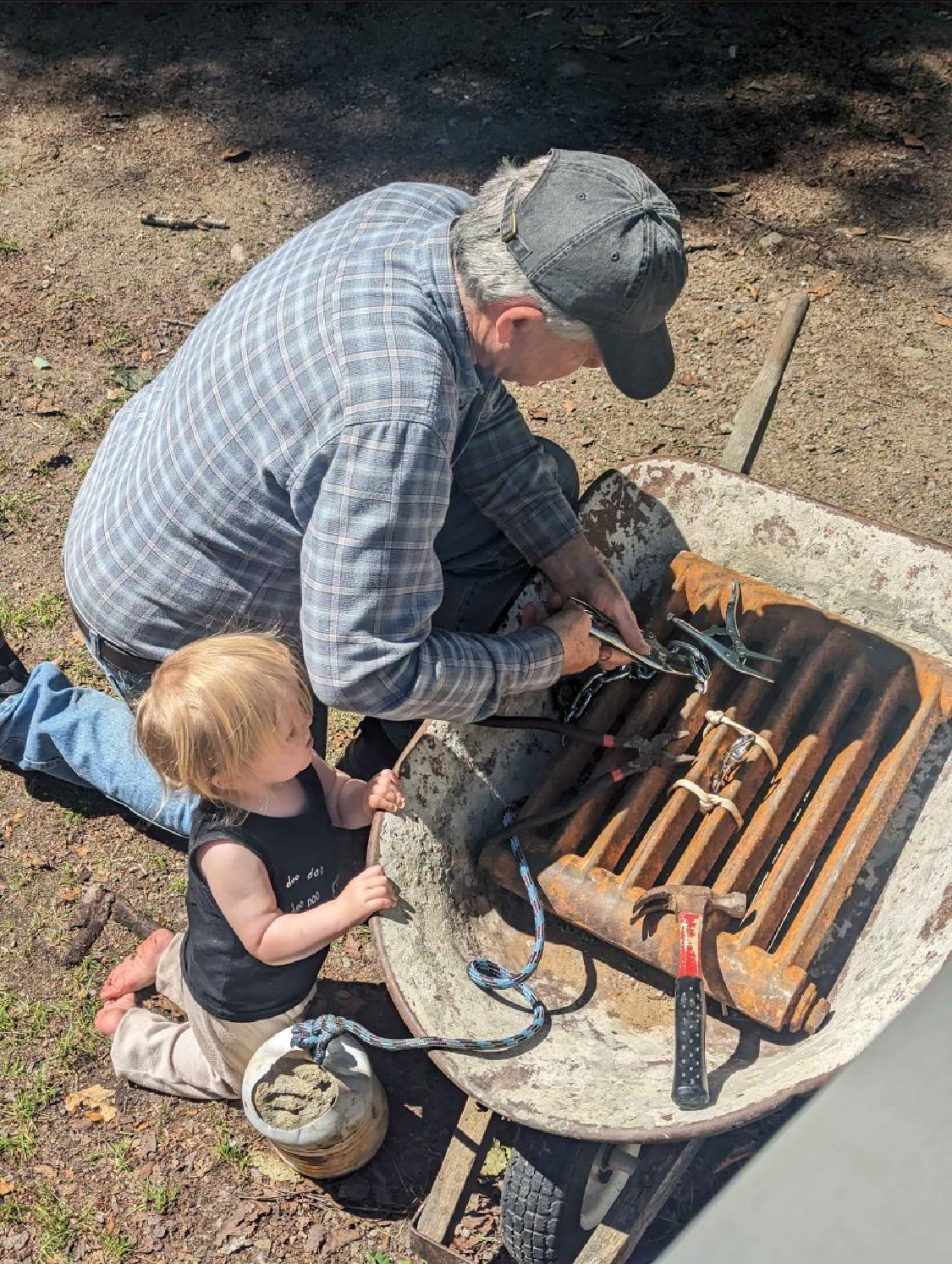
Anchor system consists of the old radiator, with chain, connected to bobber (seen next to Eldric) + a new collection of stainless-steel carabiners, jaw & eye swivels, clamps & thimbles, all laid out. Plus rope. The template for this anchor system is based on the cartoon below (Winter tether not installed yet.)

                      Team effort to handle & position the new Swim Float:

New  ladder is comfy.


Many hands really, really help!


New system will be a huge benefit for autumn chores. 

The chain assembly (secured with the tether) eliminates the need to manipulate an anchor! 


Pulling-up an 80-lb weight, on a tippy raft, after a dip into October's cold Adirondack waters is one of the least favorite chores of Happy Hollow.

Friday, June 21, 2024

Electric Safety

Camp, like many older homes, was built with ungrounded outlets. Over time, some outlets were replaced and have a modern third port, but no ground wire. So, those electric units had none of the protection of grounded circuits.

Without a grounded outlet, the risk of arcing / sparks and electrical fire are dramatically increased. Electricity is like water: it always chooses the path of least resistance. So, with ungrounded outlets, that pathway can fry an appliance, like a computer, or in the worst case, flow through a person.

This June, our engineer friend Ed Greenslit replaced 12 outlets and assured their proper grounding. 

He also worked to convert the old dock light switch to properly illuminate the two outdoor entries. Last year, he did troubleshooting for the spotlights in the parking areas.

Camp has multiple issues with contemporary Code compliance. At least one circuit breaker trips during rainstorms. Some areas lack basics, like a light switch upon entering a room.  Major concerns include unbalanced &/or overloaded circuits: the kitchen area is truly a big issue. Another concern is the water pump, which shares power with other outlets. Electricty is a benefit we easily take for granted.

 We’ll talk more at our next annual meeting.

Tuesday, May 24, 2022

Staining Project


Camp’s exterior received a cleaning-up, with a prep of steel brushing for old paint stripping, plus power washing in September 2021  


Deciding about stain color relied on a paint store  ‘visualizer;’ this helped the sisters in August 2019 to decide color possibilities for camp (given that that Papa Kurt chose a red metal roof in the 90’s).


Contractor Dave Kluska took a spray paint approach for the major stretches. Since fall, other trim was by us. Lattice panels have also gotten an update.


Friday, October 2, 2020

Raft Storage

 Overwinter support for the raft had a renovation in 2020, when a rear axel of a Plymouth Voyager was welded onto our existing 4x10 steel frame. (This was a re-use of Kurt’s old trailer, adapted to support the raft, which occurred in 2010.) 


Just schlepping the revised contraption into the Adirondacks seemed like a major achievement.


Interval step is to flip this steel structure over (so the wheels can roll on the ground). Final step was to get the whole apparatus into the water. Fortunately, this fall’s loading of the raft for winter storage seemed less stressful than previous years.


Forest-side Entry

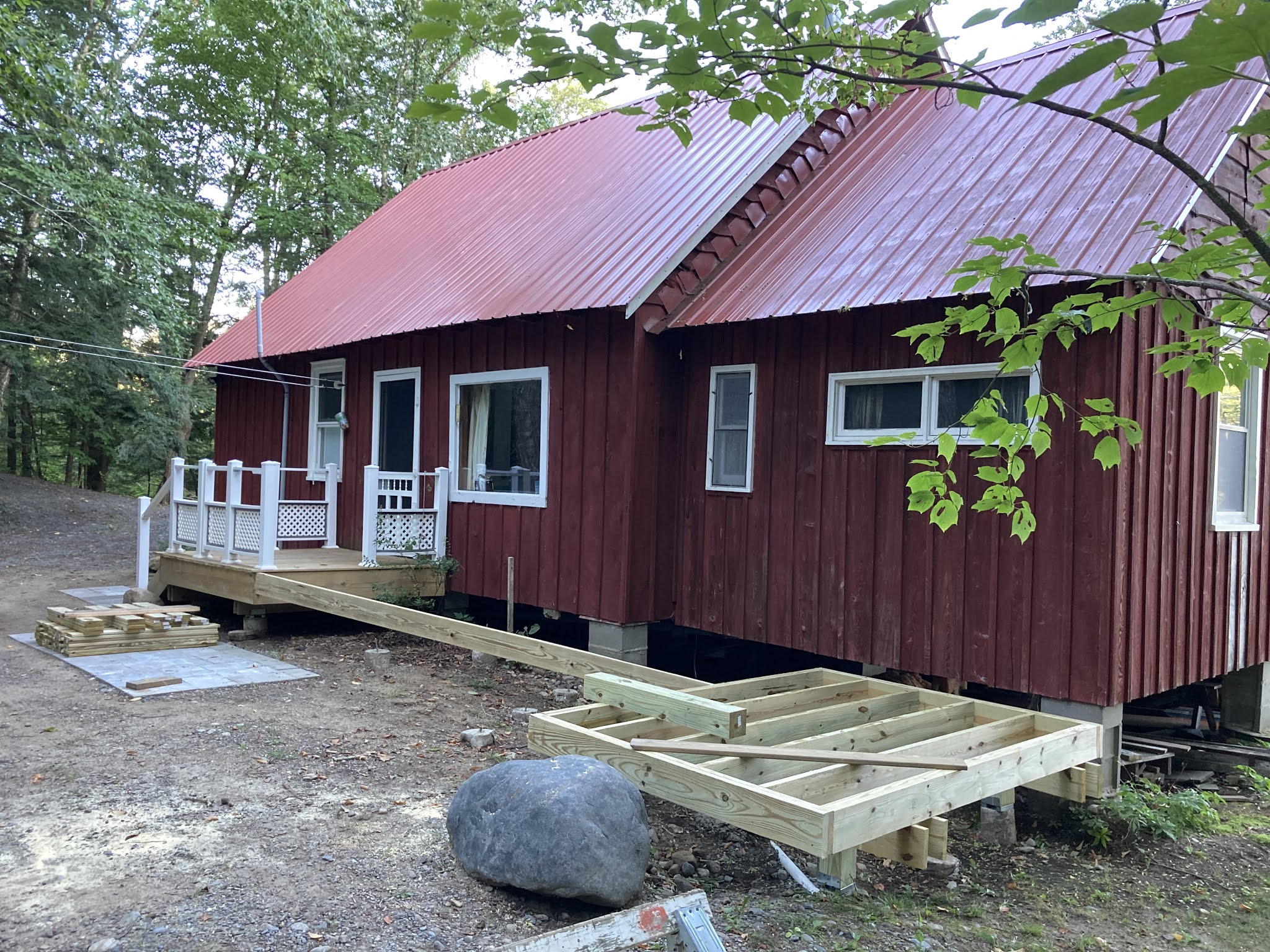
The history of building a handicapped accessible entry to the cottage started around 2004 when Kurt and Lois had worsening health issues. But finally constructing an improved access from the forest preserve & parking side of the cottage surprisingly took more than a decade to achieve.

Piers were finally ready in November 2018. The first platform was ready in June 2019. But key transition platform-work, with ramp was completed by Jason Corolito’s established craftsmen John & Gary in late 2020.


More unique puzzles will need to be solved before the completion.

Monday, June 27, 2016

Artistic Decorations on Antique Chairs


Camp chairs have enamel sketches on their backing. Some of these sketches are VERY cool.  

In 2016, we'd like to repaint the chairs, but preserve the priceless images.

When Kurt Klingbeil was youth minister at New York’s Calvary Baptist Church, members of his Manhattan youth group painted these images.  Specifically, Sid Couchey completed the image of Carol as a toddler in a dress, holding a teddy bear.  And he signed that painted chair.


Sid Couchey was developing as a cartoonist in Manhattan.  He was enrolled in the Cartoonists and Illustrators School (which since 1956 has been called the School of the Visual Arts http://www.sva.edu)

and 

also developed a strong relationship with Kurt.

Couchey worked in New York on print backgrounds for the Lassie, Big Town and Howdy Doody TV tie-in books in the early 1950’s. His first complete work was published in Hoot Gibson #6; several of his illustrated stories appear in Heroic Comics, published by Famous Funnies. You might recall him as a lead artist / principle illustrator for the 1950's Harvey Comics, with characters of Richie Rich, Little Lotta & Little Dot.  https://en.wikipedia.org/wiki/Sid_Couchey
https://artlyst.com/news/sid-couchey-little-lotta-and-richie-rich-illustrator-dies-aged-92


Check out the watercolor sketch of Kurt completed by Sid Couchey, perhaps when Kurt was about 25-years-old in 1953.  

It hangs at the staircase at camp.  The time from sketch to our discovery in Kurt & Lois’ basement exceeds fifty years.


Farewell, 1950's Vintage GE Stove

When electricity arcs through air, ozone is produced, which creates the distinctive smell associated with fried electronics.  Toxicity of smell is not the problem, but an unobserved fire would destroy camp.  When sparking from the upper burner was visible, that certainly clinched the need for our 2016 replacement stove.

Friday, September 21, 2012

Preparation

Does this sight seems familiar?  It might be a replay of the excavation from summer 2012.  On Thursday 9/20, contractor Harold Anderson began the process of replacing our septic system using a backhoe-loader, which is an optimal machine for our tight space.  He and his son, Jeremy at right, are beginning the process of excavating our old tank for a new system.


Old Out


The old, 50-year-old tank had hundreds of perforations. Removing that defective tank required another pump out.  In this same location will be a new, larger concrete septic tank.  Our intention was to maintain our existing leech field.

Excavation


The plan was to essentially "swap out" the old tank for a new version.  This system would hopefully not become a holding tank, requiring pump-outs twice a year.
Excavating into the sandy pit was unstable, and cave-ins of the wall edges were recurrent.  The water table was evident at the bottom.

Level

Making the base for the new tank into a perfectly level platform was essential.  Pea gravel was shoveled into the bottom for support.  Our contractor's son, Jeremy, did the tough, dirty work of standing in the muck and standing water, and developing it all into a supportive, level base. 
 

Delivery

Knuckle boom crane was used for delivery.  The new septic tank has a 1,000 gallon capacity;  as delivered, it weighs about 8,500 pounds.  This truck needed to be backed down our steep driveway and bring the knuckle boom close to the site.  Although this tool is very contemporary, and extremely helpful in tight spots, the operator is a crucial element.
Our cottage represents a tight spot.

Placing


Placing the tank was complex.  Trees were intrusive, driveway was awkward, space was tight.  Anxiety was high.  Warnings and stories bubbled up about prior problems:  e.g: broken cables, cracked concrete, dropped tanks, and the inability to place the tank "just right."  The immediate concern would be whether a prolonged revision of the tank placement might be required.

After two tries, the tank seated well: it was in alignment with the existing piping, it was level and it fit in the excavation.  The delivery and placement were really quite impressive.

A bit high . . . .

OK, the tank is level, and OK, it has an appropriately minimal pitch away from the cottage.  However, being seated about 3-4 inches deeper would have been optimal.  But we can't complain:  it all works!

In this picture, the tank aspect nearest the lake is even with the lawn, and the aspect nearest the woods is  5"-6" below grade.  Overall, this is just a bit high for the grade of the lawn. So the net result is that the turn in the driveway will need to be a bit higher than the original, with more pitch toward the grass and lawn.

Install Pipe

Because the tank was seated a bit high, a readjustment of the drain pipe from house to tank was necessary.  Good news is that the tank "swap out" means that we are not a holding tank, but remain a functional system.  Our outflow pipe is very slow, but adequate.  We will likely need an adjustment of our leach field out-piping in the spring.  More later.

Driveway Regrading

Regrading the driveway with a crusher run gravel is intended to make a more solid surface for our steep incline.  Hopefully, compactable coarse aggregate will 'winter over' and in 2013 should hopefully solidify into a better surface.

Wednesday, July 25, 2012

CRISIS in mid-summer with the Septic System

Septic systems are most likely to fail when stressed.  Having the cottage host a large number of guests is only one aspect of the recent septic tank problems.  Years of neglect would be the other aspect.
Camp's septic system was, in some ways, more dynamic than expected.  After installation in 1961 (per Beth's memory), it well exceeded the typical 25-year life expectancy for a metal tank.  The current tank is a five foot diameter, more than four feet deep and holds 600-700 gallons.  Location on the west wall of camp is twenty feet from exterior wall.  The drainage pipe / leach field is 75 feet long, which Papa described as longer than the typical lengths for the era at installation.This schematic is a fairly accurate representation of the camp's system, with the key exception being the presence of inspection access ports at top.  Camp had none.
The schematic shows sludge, liquid sewage and scum on top.
Opening the tank became a complex endeavor.  The routine process of episodic pumping through the years was discouraged by the requirement to excavate a two foot by five foot diameter section of the driveway area. 

Baffles

This is the more accurate diagram of our tank.
Baffles are routinely located at the entry and exit from the tank.  Baffles are important for tank function.   On the entry side, the baffle forces paper and solids downward;  on the effluent side, toward the leach field, the baffle prevents floating paper and oily scum from clogging the drainage pipes.We had two aspects to our pumping project:

Steve Cosselman's Septic Pumping was recommended by our plumber in Caroga;  the Canada Lake Store folks were able to help with an initial telephone connection.  His initial working efforts at our camp were abandoned on 7/21, since finding our tank location was too mysterious.  But he owns the specific equipment to actually pump out the tank.

Harold Anderson (standing here between father and son Cosselman) brought a small hydraulic excavator.  Excavator bucket is holding the tank cover in the picture.  Mr. Anderson took a series of tape measures, probes with metal spike, and the first gentle efforts with the excavator, then hand digging.  This gave us access to the tank cover (Yee ha!)